
Cornerstone is one of America's Best Colleges according to the Wall Street Journal

Academics

Adult female meeting with female student at a table with a laptop and coffee cups

Admissions

De Witt Center for Science and Technology at Cornerstone University

Tuition & Financial Aid

Students giving high fives after Powderpuff football game

Student Experience

Cornerstone is one of America's best online colleges according to Newsweek

Online

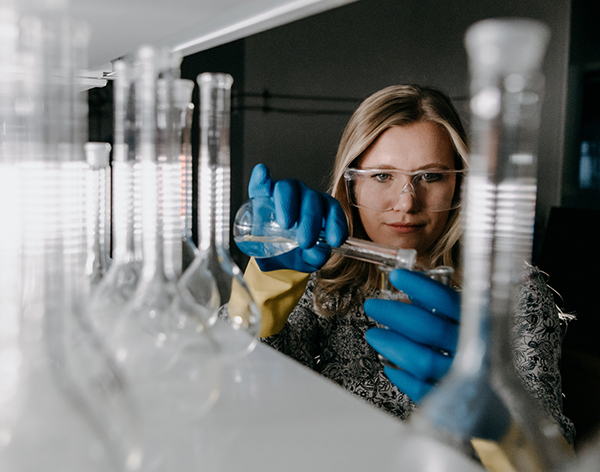
Chemistry student Chemistry student Chemistry student

Minor in

Chemistry

On-Campus

REQUEST INFORMATION

Loading...

Turn Science into Impact with a Chemistry Minor

Chemistry plays a vital role in healthcare, innovation, environmental stewardship, and education. Cornerstone University offers two pathways — a general Chemistry Minor and a Chemistry for Secondary Teachers Minor — so students can align chemical study with broader professional goals or preparation for teaching. The general chemistry minor enhances the B.S. in Biology for students interested in medical, dental, pharmacy, veterinary or research careers. Grounded in a Christian worldview of God’s order and design, the minor equips students to apply chemistry to real-world challenges that improve health, advance technology, protect the environment, and educate future scientists.

For more opportunities to advance your career impact, explore our B.S. in Biology, B.A. in Biology, B.S. in Environmental BiologyB.S. in Elementary Education, or B.S. in Secondary Education. Cornerstone offers focused concentrations through the B.S. in Biology major, including: pre-medical, pre-dental and pre-veterinary.

Develop Market-Ready Skills with a Minor in Chemistry

Gain practical, highly valued skills that strengthen your major and your résumé for science-based professions or secondary teaching careers, including:

Analytical Problem-Solving – Apply chemical principles to analyze data, identify patterns, and solve complex scientific problems.

Laboratory & Technical Skills – Use standard laboratory techniques, instrumentation, and safety practices to support testing, research, and quality processes.

Quantitative Reasoning – Interpret measurements, calculations, and data accurately to support evidence-based conclusions and sound decision-making.

Scientific Communication – Explain chemical concepts clearly through written, visual, and verbal communication in professional or classroom settings.

Process & Systems Thinking – Understand how chemical reactions, materials, and processes function within larger scientific, industrial, and environmental systems.

Icon: Cross

Christian Worldview Integration – Approach chemistry as a God-given calling by studying the material world through a biblical understanding of order, purpose, and stewardship.

Program Courses

Study the life sciences through a focused curriculum offered in two tracks: the Chemistry Minor and the Chemistry for Secondary Teachers Minor. Both tracks share the same core chemistry coursework, building a strong scientific foundation while supporting distinct career goals.

Chemistry Minor

CHM-121: General Chemistry I

Study the composition and properties of matter, atomic structure, and thermodynamics, with attention to biblical stewardship in chemical use and disposal.

CHM-122: General Chemistry II

Continue the study of chemical principles with emphasis on reactions, rates, equilibria, electrochemistry, and qualitative analysis, with attention to environmental responsibility and safe chemical handling and disposal.

CHM-230: Organic Chemistry Lab I

Apply laboratory methods and techniques for the synthesis and analysis of organic molecules.

CHM-231: Organic Chemistry I

Understand the structure, bonding, reactions, and spectroscopic characterization of carbon-based compounds.

CHM-232: Organic Chemistry I

Continue exploring organic chemistry, focusing on polyfunctional compounds and biologically significant molecules. Investigate natural product synthesis and polymer chemistry.

CHM-411: Perspectives in Chemistry

Examine the history, ideas, and methods of chemistry, with emphasis on its role in technology, society, and responsible stewardship in production, use, and disposal.

View all of the courses for your academic program.

View the Academic Catalog

Chemistry for Secondary Teachers Minor

CHM-121: General Chemistry I

Study the composition and properties of matter, atomic structure, and thermodynamics, with attention to biblical stewardship in chemical use and disposal.

CHM-122: General Chemistry II

Continue the study of chemical principles with emphasis on reactions, rates, equilibria, electrochemistry, and qualitative analysis, with attention to environmental responsibility and safe chemical handling and disposal.

CHM-230: Organic Chemistry Lab I

Apply laboratory methods and techniques for the synthesis and analysis of organic molecules.

CHM-231: Organic Chemistry I

Understand the structure, bonding, reactions, and spectroscopic characterization of carbon-based compounds.

CHM-232: Organic Chemistry I

Continue exploring organic chemistry, focusing on polyfunctional compounds and biologically significant molecules. Investigate natural product synthesis and polymer chemistry.

CHM-411: Perspectives in Chemistry

Examine the history, ideas, and methods of chemistry, with emphasis on its role in technology, society, and responsible stewardship in production, use, and disposal.

View all of the courses for your academic program.

View the Academic Catalog

Enhancing Your Career with a Chemistry Minor

The Chemistry Minor and Chemistry for Secondary Teachers Minor expand career options by strengthening analytical and scientific skills valued across today’s workforce. Students apply chemical understanding to healthcare, manufacturing, environmental science, and laboratory roles, while those pursuing secondary education develop the content expertise needed to teach chemistry with confidence.

Your Degree Starts Here

Take your next step toward learning at one of the most affordable Christian universities in the nation.

  1. Apply — our application is free.
  2. Set goals — your admissions counselor is here to guide you.
  3. Maximize your credits — you could transfer in up to 75% of your degree credits.
  4. Discover affordability — scholarships and grants are available for qualified students.

Cornerstone University

Hours

MON - FRI: 8 a.m. - 5 p.m.
SAT & SUN: Closed

Want To Learn More About CU?

Connect With CU