


Special Easter Reflection from President Gerson Moreno-Riaño
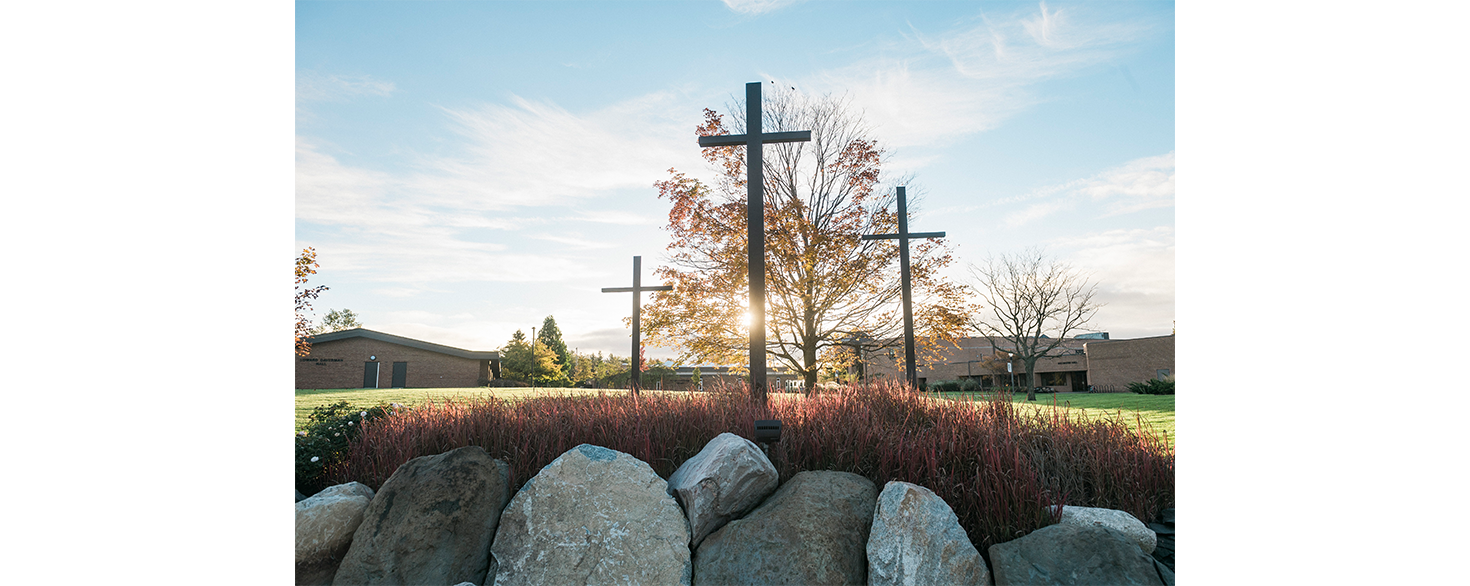
“And Jesus going up to Jerusalem took the twelve disciples apart in the way, and said unto them, Behold, we go up to Jerusalem; and the Son of man shall be betrayed unto the chief priests and unto the scribes, and they shall condemn him to death, and shall deliver him to the Gentiles to mock, and to scourge, and to crucify him: and the third day he shall rise again.”
— Matthew 20:17-19 —
In Matthew 20, Jesus begins His journey to Jerusalem for what will be His final days before His crucifixion and resurrection. And for a third time, He predicts His death to the twelve disciples.
We may wonder in amazement at the prophetic words of Christ. Easter and Holy Week so often focus, and rightly so, on the prophecies foretelling the birth, life, and suffering of the Messiah. One of the scriptures my Christian elementary school required that its students memorize was Isaiah 53. Decades later, I can still recall the powerful words of Isaiah as he, inspired by the Holy Spirit, foretells the great suffering of Jesus Christ, God’s Suffering Servant:
“Who hath believed our report? and to whom is the arm of the Lord revealed?
For he shall grow up before him as a tender plant, and as a root out of a dry ground: he hath no form nor comeliness; and when we shall see him, there is no beauty that we should desire him.
He is despised and rejected of men; a man of sorrows, and acquainted with grief: and we hid as it were our faces from him; he was despised, and we esteemed him not.
Surely he hath borne our griefs, and carried our sorrows: yet we did esteem him stricken, smitten of God, and afflicted.
But he was wounded for our transgressions, he was bruised for our iniquities: the chastisement of our peace was upon him; and with his stripes we are healed.
All we like sheep have gone astray; we have turned every one to his own way; and the Lord hath laid on him the iniquity of us all.
He was oppressed, and he was afflicted, yet he opened not his mouth: he is brought as a lamb to the slaughter, and as a sheep before her shearers is dumb, so he openeth not his mouth.
He was taken from prison and from judgment: and who shall declare his generation? for he was cut off out of the land of the living: for the transgression of my people was he stricken.” (Isaiah 53:1-8)
It is right and proper for us to be awestruck as we read the prophecies of Christ’s suffering and consider Christ’s own foretelling of His suffering, death, and resurrection. Such prophecies are sobering and should fill our hearts with gratitude and reverence for God’s awesome purposes.
But for a moment during this Holy Week and Easter, let’s pause and reflect on the incredible courage and obedience of Christ. What arrests my attention when I consider Christ foretelling His own suffering and death, is the fact that He not only foretells it, He goes through with it accompanied by a moral necessity that fills my heart with both gratitude and longing.
Christ knew the terrifying days and events that awaited him in Jerusalem. And He tells his disciples that “he must go unto Jerusalem” (Matthew 16:21). My heart fills with gratitude for the singular courage and obedience of Jesus Christ because my salvation — my redemption and that of all peoples and the created order — is a result of Christ’s singular courage and obedience. He must go to Jerusalem because there is sometime of existential importance that He must do. Nothing could deter Christ, not even the worst suffering imaginable. He had to go because He had to fulfill the Father’s will.
My heart is also filled with longing. My heart yearns and longs for the courage and obedience of Christ to be in me. I long for the courage and obedience which Christ displayed during Holy Week and Easter to be more fully manifested in my life, my thoughts, my words, my actions. Paul’s words in Philippians ring in my ears:
“Let this mind be in you, which was also in Christ Jesus: Who, being in the form of God, thought it not robbery to be equal with God: But made himself of no reputation, and took upon him the form of a servant, and was made in the likeness of men: And being found in fashion as a man, he humbled himself, and became obedient unto death, even the death of the cross.” (Philippians 2:5-8)
As we reflect, lament, and rejoice over Easter and the events of Holy Week, we must allow Paul’s exhortation to the Philippians to renew our minds, hearts, and lives. And we must commit ourselves to the same courage and obedience that our Lord and Savior Jesus Christ exemplified during the most terrifying time of His life so that we could enjoy the greatest triumph the world will ever know — the conquest of sin, death, and the grave!
Yes, must is strong language. But that is the example of our Savior, the exhortation of God’s Holy Word, and the requirements of following Jesus. As Paul Kingsnorth, the Irish novelist, poet and essayist, writes in his conversion autobiography, “I have to pick up my cross and start walking.”1
Yes, let’s pick up our crosses and start walking for Chris is risen, He is risen indeed!
Gerson Moreno-Riaño, Ph.D.
President
Cornerstone University
1See Paul Kingsnorth, “The Cross and the Machine.” First Things, June 1, 2021 (https://firstthings.com/the-cross-and-the-machine/).


